
Restoring grassland after mouse damage
Mice can cause significant damage to grassland fields. Especially during relatively dry and mild winters, they have free rein. From their underground tunnels, they eat the roots of the plants. The result: bare patches in your grassland where weeds and undesirable grasses (such as rough bluegrass) quickly take advantage. If you do not take action, you will harvest less forage in the spring and the quality of your forage will be dramatically reduced.
Repair damage early in spring
So take action early in the spring. This helps limit forage losses. Depending on the severity of the damage, you can reseed or overseed the field. The period from February to mid‑March is ideal for this. Your choice of grass variety depends on how you intend to use the field within your dairy operation. Your forage position and crop rotation plan are important starting points when selecting the right grass.
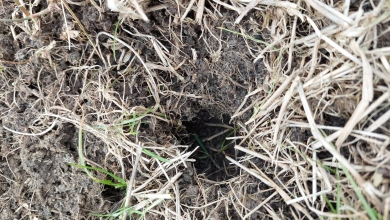
Step-by-step plan for restoring grassland after feeding damage
Step 1. Assess the field
Is recovery still possible, or is there so much weed pressure and/or poor‑quality grasses in the field that it is better to completely reseed?
Use the following rule of thumb:
Reseed when:
- Less than 60% desirable grasses
- More than 20% couch grass
- There is structural damage caused by mouse activity
Overseed when:
- There are 60–80% desirable grasses
Step 2. Soil preparation
A proper soil preparation is essential for successful grassland restoration.
Discuss the best approach with your contractor. In the past, very good results have been achieved using an overtop rotavator for reseeding.
Step 3. Weed control
You have several options for weed control:
- Is weed pressure low? Choose a mechanical approach by using a tine weeder. This removes weeds and dead organic material.
- Is weed pressure high? Choose chemical weed control. Chickweed can be treated early in the spring with products that are effective at low temperatures. Couch grass can be controlled more effectively during the growing season. After spraying, wait at least one week before reseeding or overseeding the field.
If you choose to overseed first and then control the weeds, wait two weeks after overseeding before applying the weed treatment.
Step 4. Choose the right grass seed mixture
The right grass seed mixture depends on how you intend to use the field and for how long. Different solutions are available for short-term, medium-term and long-term grassland restoration. When making your choice, consider the desired lifespan of the grassland, your forage requirements and the level of investment that fits your farm.
For short-term use, the focus may be on rapid establishment and quickly replenishing forage stocks. For a longer period of use, yield, persistence and sward quality become increasingly important. Choose the solution that best matches your farm's forage strategy and crop rotation.
Mixtures for restoring grassland after mouse damage

Intermezzo
-
Ideal for sowing after cereal, vegetables or maize.
-
Can be sown into cover crop: cereals (spring) or maize (at 40 cm plant height).
-
Fast-establishing, late-heading.

Topsilo
-
High-performance forage for top-yielding dairy cows
-
Fast and efficient ensiling thanks to high natural sugar content
-
Enriched with red and white clover to boost protein levels
Tornado
-
Gives your forage position a significant boost
-
Flexibility in your crop rotation
-
Persistent and easily accessible