
Sowing a horse pasture
Sowing a horse pasture takes time and attention, but in return you will enjoy an excellent pasture for many years to come. If you are unable to sow your horse pasture yourself, you can ask your local contractor for assistance.
Contractors have the expertise and the right equipment to establish a high-quality horse pasture. It is important that your contractor uses grass seed specifically suited to horse pastures. If you have not yet purchased grass seed yourself, be sure to discuss this with your contractor.
Preparation
The first step in establishing a horse pasture is to eliminate weeds. Weed control products can be obtained through your local agricultural distributor or contractor. The existing sward can then be cultivated and ploughed to a depth of approximately 20 cm. This helps bury weed seeds, improves soil aeration, and enhances nutrient uptake. Afterwards, allow the soil to settle for at least one week.
The next step is to create a fine seedbed using a power harrow. Repeat this process until the soil particles are no larger than 1 cm. The field should now be level, with a loose top layer of 1 to 2 cm, and ready for grass seed sowing.
Sowing
Spring and early autumn are ideal times for establishing grassland. During these periods, temperature and moisture levels provide optimal conditions for grass germination and growth. The soil temperature should be at least 8°C (which can be measured easily). Try to sow before expected rainfall. The latest time to sow Horse Master® is the end of September. Hay Master should be sown before 15 September. Sowing later may prevent the young grass plants from developing sufficiently before winter, increasing the risk of frost damage.
Small areas can easily be sown by hand. Distribute the grass seed evenly across the field, lightly rake it in, and then firm the seedbed by rolling or treading it. Larger areas are best sown using a specialist grass seeder. Do not sow deeper than 1.0-1.5 cm. Roll the seedbed immediately after sowing.
To sow one hectare, you will need 80 kg of Horse Master®. If the field is intended primarily for mowing, 50 kg per hectare is sufficient.
After sowing
Ensure adequate moisture after sowing until the grass is well established. Once the grass reaches a height of 6-8 cm, it is advisable to apply a fertiliser.
This is also the best time for chemical weed control. Do not wait too long, as weeds may otherwise outcompete the young grass plants. Avoid creating wheel tracks or other machinery damage in the pasture. After sowing, the pasture should not be used for approximately two months. The grass should be mown at least once before grazing. For the first cut, the grass should be approximately 15 cm tall. Any bare patches can be reseeded, and the pasture can, if necessary, be supplemented with additional nutrients (nitrogen, potassium and phosphorus). Your pasture is then ready for grazing.
A strong, green pasture for your horse
A beautiful green pasture with a durable sward and sufficient grass to graze your horse every day. This is the wish of every horse owner. Unfortunately, many horses are still kept in trampled pastures sown with grass intended for cattle. This can lead to a range of health issues. That is why Barenbrug developed Horse Master®.
Horse Master® is a balanced grass seed mixture. A Horse Master® pasture provides a durable sward, rapid regrowth, and grass that is rich in structure and low in fructan.
Learn more about Horse Master®.
Healthy forage for horses

Hay Master
-
Fresh and tasty hay for your horse, cows or small livestock
-
High roughage production
-
Excellent drought resistance
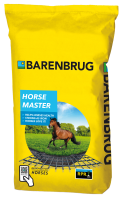
Horse Master
-
Plenty of grass for grazing
-
Highly resistant turf with RPR technology
-
Good regrowth